| 
LumiNova® was chosen as Most Innovative Product in Japan in 1993. "Glows 10 times brighter, 10 times longer" What is LumiNova®
LumiNova® is a class of newly developed phosphorescent (glow-in-the-dark) pigments which are based on Strontium Oxide Aluminate Chemistry. They are drastically different from conventional phosphorescent pigments which are either based on Zinc Sulfide or on radioisotopes for their self-luminous properties.
LumiNova® was invented and developed by NEMOTO CO. LTD. of Tokyo, Japan. Nemoto has been in the luminous pigments business since 1941 and is one of the leading phosphorescent pigment manufacturers in the world.
LumiNova® Pigments are in the TSCA inventory and NEMOTO CO LTD., Ltd. was granted the US Patent in 1995 and since then in many other countries worldwide. LumiNova® Features - Afterglow period of ten times current ZnS based phosphorescent pigments.
- Activation by a wide wavelength band (200-450 nm) but best results are obtained with an activation energy under 350 nm;
- Initial afterglow brightness of up to ten times that of conventional phosphorescent pigments;
- Increase in luminescence and afterglow with longer activation time;
- Excellent weather and light fastness;
- Free of hazardous and radioactive substances
LumiNova® Applications
LumiNova® was originally developed to satisfy the current and future needs of the clock, watch and the instrument dial industries, but soon it was found out that like many other new products, the application possibilities are almost limitless. Examples include:
- Clock Watch dials
- Electronic instrument dial pads
- Home appliances
- Lighting apparatus and switches
- Exit sign boards
- Emergency signage and low level lighting escape systems
- Aircraft and automobile dials and Instrument panels
- Firemen's equipment
- Military applications
- Outdoor path marking
- Camping equipment
- Textile printing and textile fibers
- Writing printing inks
Other applications where a long afterglow and/or light fastness is needed: - Afterglow period of 10 times current ZnS based phosphorescent pigments.
- Activation by a wide wavelength band (200-450 nm) but best results are obtained with an activation energy under 350 nm;
- Initial afterglow brightness of up to ten times that of conventional phosphorescent pigments;
- Increase in luminescence and afterglow with longer activation time;
- Excellent weather and light fastness;
- Various colors;
- Free of hazardous or radioactive substances;
| | LumiNova®
Green | LumiNova®
Blue Green | Conventional
Phosphorescent
Pigment | | Chemical Identity | Strontium Oxide | Strontium Oxide | ZnS:Cu | | Body Color | Light Yellowish Green | Light Blue | Yellowish Green | | Avg Particle Size | 1.5 - 40mm6 | 1.5-20mm6 | 20-40mm | | Excitation by | 200-450nm | 200-450nm | 200-450nm | | Emission at (peak) | 520nm | 490nm | 530nm | | Afterglow Brightness1 | » 300mcd/m2 | » 200mcd/m2 | 20-30mcd/m2 | | Afterglow Extinction2 | >2,000 min | >2,000 min. | 200min. | | Excitation Time3 | » 30 min. | » 30 min. | 4 min. | | Light Fastness4 | > 1,000 hours | > 1,000 hours | 10-24 hours | | Chemical Stability | Excellent (Except Water) | Excellent (Except Water) | Poor to Good | | Specific Gravity5 | 3.6 | 3.9 | 4.1 | (1) Brightness after 10 min., excitation with a D65 illuminant for 4 min. at 200 lux.
(2) Time span necessary for afterglow brightness to diminish to .32 mcd/m2 (100 times the human eye perception limit)
(3) Time required for saturation with standard D65 illuminant at 200 lux.
(4) Time required for initial afterglow to drop by 20% after irridation with 300W high pressure mercury lamp (accelerated light fastness test)
(5) In powder form
(6) Depends on type of LumiNova® (different particle sizes available) Luminova Graphs Diagrams
The Photographs and 3-D diagrams shown below illustrate the superiority of LumiNova® over conventional pigments. Both test surfaces were activated under a standard light source of 1,000 lux for 5 minutes. The afterglow images were obtained using a CCD camera at 5min., 60min., and 500 min. intervals after removal of the excitation source. The photometrically measured afterglow intensities at each time period are illustrated by the 3-D diagrams, while the photographs show the actual brightness difference between the two pigments.
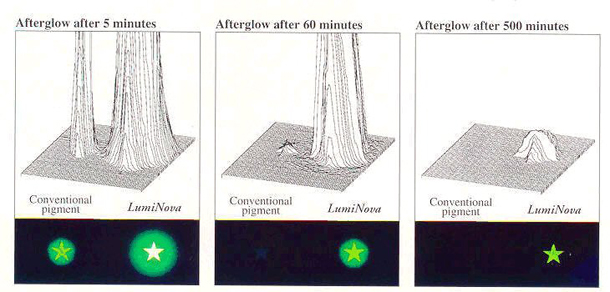
It is obvious from the unretouched photographs and 3-D diagrams that LumiNova® is 10 times superior both in initial brightness and length of afterglow to conventional phosphorescent pigments. Less LumiNova® yields better brightness, thanks to its smaller specific gravity and higher bulk density.
If your application needs a pigment that will glow all through the night, then you need LumiNova®! | 










