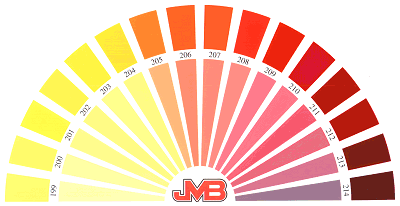
James M. Brown manufactures a complete range of cadmium pigments from a greenish yellow through orange and red to deep maroon. As well as offering a range of standard pigments on its shade card, JMB offers a matching service against pigments which customers may already be using.
JMB cadmium pigments are manufactured using very high purity raw materials and all batches undergo special treatment during processing which enables them to comply with special requirements e.g. those of the Council of Europe for pigments in food-contact plastics.
These products also comply with the requirements of the US "TCLP" and are not, therefore, classed as being hazardous for disposal in the USA.
The European Commission has completed the first comprehensive risk assessment of cadmium pigments and has concluded that they produce no significant risk either to man or to the environment.
The manufacture and supply of cadmium pigments by JMB is covered by a formal quality system conforming to ISO 9001 (2000) with BSI QA.
Applications:
Plastics (general)
Cadmium pigments have inherent high temperature resistance because of their method of manufacture and may therefore be used routinely in polymers which are processed at or above 300ºC e.g. polycarbonate, nylons and PTFE. Further, because of this high temperature resistance, all moulding sprues and off-cuts can be recycled whereas an organic may already be starting to undergo decomposition during moulding and be unable to withstand further heating.
Toys
The use of colourants in toys is controlled in the EU by European standard EN 71 part 3. JMB has carried out tests on a wide variety of plastics moulded with up to 1% of its full-strength cadmium pigments. In all cases, the amount of cadmium extractable from the moulded article was at least a factor of ten below the maximum limit set in EN 71 part 3.
Artists' colours
Cadmium pigments have long been the standard against which other pigments are judged by artists and they continue to be the only choice for top-quality oil and water colours.
Ceramics
The colouration of decorative ceramic products such as on-glaze colours, porcelain enamels for steel and glass colours for both flat glass, tumblers and bottles often depends on the use of cadmium pigments. They are the only pigments available for bright yellows, oranges and reds (which continue to be such popular colours) which are capable of withstanding the firing processes during manufacture and application.






 Cadmium Pigments